
Tycoon Games: Choose Better Upgrades by Finding the Bottleneck
A bigger operation is not always a more productive one. Find what is slowing progress before spending your next upgrade.
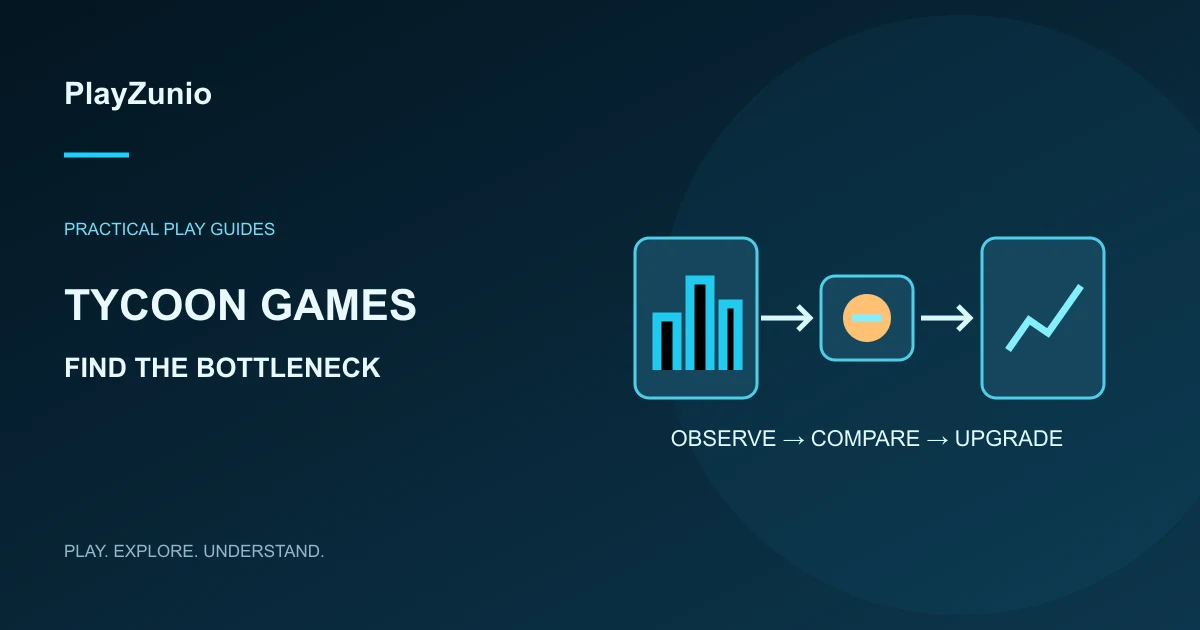
In tycoon games, the best next upgrade is often the one that removes the current bottleneck. Watch where customers, goods or workers wait, compare the upgrade's cost with its likely benefit, and check whether the rest of the operation can use the added capacity. Expanding a fast part of a slow system may achieve very little.
Explore PlayZunio's tycoon games and read the selected game's objective first. Some emphasize active movement, others repeated production or gradual expansion. This guide concerns fictional in-game resources; it is not advice about real-world investment or a promise that every game uses the same economy.
Map the operation before buying
Describe the process in a few steps. For example, goods might be produced, transported and sold. A service game might require visitors to arrive, receive attention and leave. Watch a complete cycle and notice where work accumulates.
If completed goods pile up, faster production may not help until transport or sales improve. If a worker waits with nothing to do, hiring another worker with the same task may duplicate idle capacity. The visible queue is often more informative than the most expensive button in the upgrade menu.
Compare upgrades on the same basis
Where the game shows reliable numbers, compare additional output against cost. Imagine one fictional upgrade costs 100 coins and adds 10 coins per minute, while another costs 300 and adds 15. Under those simplified conditions, the first takes 10 minutes to repay its cost and the second takes 20. These are illustrative numbers, not values from a PlayZunio title.
The calculation is only useful if demand, supply and the rest of the process can support the extra output. A larger counter can still help little when no customers arrive. A capacity upgrade can be valuable without increasing the displayed income rate if it prevents frequent interruptions.
Three questions before spending
- What limits progress now? Look for waiting, overflow or repeated manual trips.
- What will this purchase change? Separate speed, storage, automation and access to a new area.
- What happens immediately afterward? Check whether the purchase leaves enough resources to operate the new feature.
Keep the answer concrete. “It is the next unlocked upgrade” is not the same as “it clears the queue that stops sales.” Sometimes the next area is required for an objective; in that case, the objective can reasonably outweigh short-term efficiency.
Automation changes how you spend your attention
An automated task may let you manage another part of the operation. Evaluate it against what you will actually do with the freed time. If it removes a repetitive action you dislike, that can be worthwhile even when another upgrade produces a slightly larger number.
Check what automation does and does not cover. A worker might transport goods without restocking a different station. Watch the system after buying rather than assuming every remaining task is handled. Make one meaningful change at a time so you can see its effect.
Do not assume progress continues after closing
Offline production, saving and reset systems vary. Before ending a long session, look for the game's own save confirmation and read any reset description carefully. A reset may exchange current progress for a longer-term benefit, but the details are title-specific. Do not press it just because the button becomes available.
Our browser save-data checklist explains what to check before clearing browser storage or changing devices. If you prefer planning without a growing economy, try strategy games; for a broader range of modeled activities, browse simulation games.
Quick answers
Should I buy the cheapest upgrade first?
Only if it solves a useful problem. A cheap improvement to an already idle station can still be a poor choice.
Why did income barely change after an upgrade?
Another stage may be limiting output, or the upgrade may increase capacity rather than immediate income. Observe a complete cycle.
Are idle and tycoon games the same?
The categories overlap, but the labels alone do not establish how much active input, automation or offline progress a particular game supports.