
Platform Games: How to Practice Jump Timing and Safer Landings
Aim for the landing, not just the gap. Learn a repeatable way to diagnose short jumps, overshoots and moving platforms.
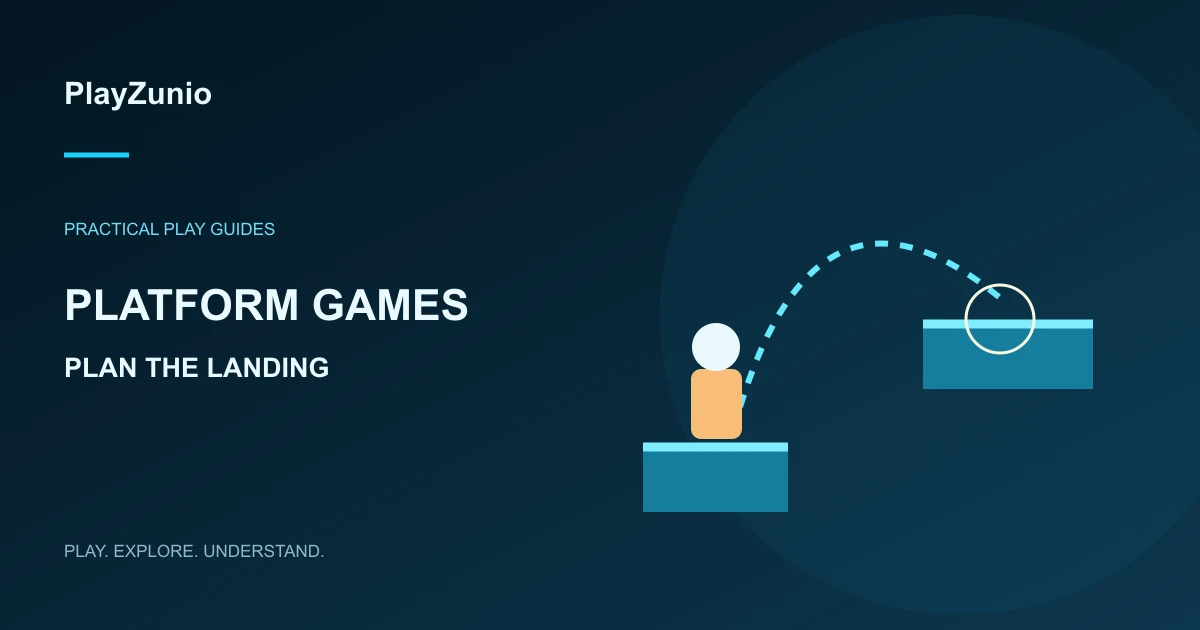
In platform games, a reliable jump starts with a clear landing target. Learn how far the character travels from a standing start, how movement changes that distance, and whether holding the jump button changes height. Then practice one difficult section at a time instead of changing several inputs on every attempt.
Browse PlayZunio's platform collection for jumping challenges. Different games deliberately use different movement rules. Some reward precise stops; others preserve momentum or add unusual hazards. The method below helps you discover those rules without assuming a particular game's abilities.
Test movement on safe ground
Make a short movement input and release it. Does the character stop immediately or continue sliding? Next, compare a standing jump with a jump made while moving. If the game allows it, compare a quick tap of jump with a longer hold. These simple checks reveal more than attempting the hardest visible gap immediately.
Do not assume double jumps, wall jumps or last-moment forgiveness exist. Use the instructions or a safe test to confirm an ability before depending on it above a hazard. A mechanic remembered from another game can be the reason a seemingly correct attempt keeps failing.
Pick a landing zone with room to recover
The near edge of a platform may be enough to survive, but the center often gives more room for the next action. Before jumping, look at what happens after landing: a moving obstacle, another gap or a narrow ceiling can make a rushed second jump dangerous.
On a moving platform, observe a complete movement cycle if there is a safe place to wait. Plan where the surface will be when you arrive, not where it is when you press jump. Begin with a broad landing opportunity instead of trying to catch the platform at the most awkward end of its path.
Diagnose the miss
| What happened | What to inspect |
|---|---|
| Fell short | Takeoff position, movement speed and jump duration |
| Passed the far edge | Horizontal input after takeoff and stopping distance |
| Hit the underside | Jump started too late or from the wrong position |
| Landed, then slipped off | Residual movement or a rushed next input |
Choose one likely cause and test one correction. If you move the takeoff point, hold jump longer and reverse direction all at once, success tells you little about which change helped. Repeatability is more useful than one lucky landing.
Break a difficult sequence into landmarks
Use visible details to remember the route: jump near a particular floor tile, pause on the wide ledge, then wait for the hazard to pass. Keep these cues tied to the game world rather than a fixed number of seconds, especially when the character can approach at different speeds.
If checkpoints are available, use them to practice the next section. If restarting returns you to the beginning, make the early section consistent before attempting faster routes. Avoid treating every easy jump as a chance to experiment when you are trying to learn one later obstacle.
Separate input trouble from timing trouble
If keys suddenly stop responding, check focus before changing your technique. A keyboard combination may also fail while individual keys work. For that situation, see the keyboard input checklist. On mobile, use the game's supported controls and leave enough space for your fingers to see the landing area.
For a slower planning break, try puzzle games. For movement with an automatic forward pace, browse arcade games and our endless-runner practice guide.
Quick answers
Should I always jump from the very edge?
No. The useful takeoff point depends on speed, jump distance and the landing area. Choose a repeatable point with enough margin.
Why do I overshoot after releasing movement?
The game may preserve momentum. Test stopping behavior on safe ground before relying on an immediate stop.
Does every platformer support a double jump?
No. Confirm the controls for the specific title; do not build a route around an unverified ability.